All is fair on Dydd Santes Dwynwen
25 Jan 2026 - VelikTzar
Words: like 2000? Less, really, the meat of it is ~1000. Time: 5 min (or 10, if you're a dumb moron!!)
Dear Reader,
It has been a long time that we’ve been apart, but I have returned. There would have been a great post talking about the New Year, but a month in and it is clear,
it was never meant to be. Gone are the grand declarations of the festive days, gone are the visions of a different future, gone like the holiday snow quickly melted by the still-warm ground, gone like the Sun that is now (as yours truly is writing this) setting on the other side of the canal, leaving us into shadow. Gone like the dreams of victory in 1914, crushed under a million boots in the French mud. Which is not to say that the New Year is not useful as a symbol, and a delineating line. But there can be no great change, and no great beginning when one is alone. How, how can one race forward and throw themselves into the open maw of the world, embrace all that fickle Fortune throws at them, embrace the spectrum of emotion, from the heights of transcendent joy to the depths of despair, and say yes to all of life’s pleasures and sorrows, how can one live without company? and they’re all gone now, and you are last as you were first. Aristotle is evil, that much is true, but he was right when he said that “Anyone who either cannot lead the common life or is so self-sufficient as not to need to, and therefore does not partake of society, is either a beast or a god.”. And I, oh God I am beautiful, oh God I’m wonderful, I’m marvelous, intelligent, so why doesn’t that make me feel better?
But regardless, there is no past, and there is no future; what do I care for the warmth of summer, when it is not here to warm me now? Indeed, it was perhaps never real, there never was a summer, just like the invigorating spirit of the weeks past, when I sat atop the world and looked down on it all, nothing but the fresh air and snow, and the howling wind, and countless valleys unfolded before me, and as I went down amidst the trees I could say that life was good, and that my mind was clear, as was the road ahead. No, none of it was ever real, there is only a new prison, with a different view, but it all stays the same. Was there even an old prison? It seems unimaginable now! What does it matter that I now look upon the wonders of Man, as opposed to the rolling hills covered with sheep? For all I care, put a screen there with the Nebraskan countryside on it like in Fallout, it’d be all the same!
No, gone are the joys and sorrows of yesteryear, and there is no future conceivable but that which is now, there is naught but the present, and it could never be otherwise. Unchanging, unfeeling.
Welcome back!
***
Before my long absence, barring my missive from my northern prison the other month, the last post was yours truly being sick on Valentine’s day. A sad occasion, and the wretched holiday nears yet again! Last time we looked at St Tryphon’s Day, a great holiday on the same day in the Balkans (and what a great love of wine you have! though sadly, not the expertise to truly appreciate it). Regardless, it is only fitting that your great return be on another day about love, that being today, of course, the 25th of January, which happens to be St. Dwynwen’s day, the Welsh patron saint of lovers (and sick animals, farmer’s beasts too, and diver’s aches; what a combination).
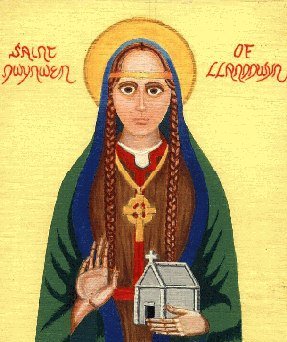 Blessed Dwyn, I could not find a source, I am sorry.
Dwyn Wen, Blessed Dwyn! Her story, let’s start with her story. She loved a man named Maelon Dafodrill, but he wanted to have sex with her before marriage, she said no, he did not respect her boundaries and left in rage (men, am I right) and “aspersed” her. She asked God for help (as she should have, considering most of her over 60 siblings were saints) and fell asleep. Then God cured her of her love with a “delicious liquor” (lucky girl) and gave the same thing to Maelon, who turned to ice (you could say she really let it go (I’m sorry)). Then the genie God gave her three wishes, and she wished that, firstly, Maelon be unfrozen (what was the point of all that?), that “her supplications should always be granted in favour of all true-hearted lovers, so that they should either obtain the objects of their affection, or be cured of their love-passion”, and that she should never wish to marry. Then she became a nun, and lived on Ynys Mon, and had a church (on Ynys Llanddwyn (don’t ask me to pronounce it though); her name is also in Porthddwyn), and became a saint, which seems to have been par for the course considering her father.
Great, right? The quotes in the paragraph are from Iolo Morganwg, and if you know anything about him, well, he wasn’t the most trustworthy fellow. But that doesn’t matter, does it? True love cares not for reason. We believe this, and for that today Beautiful Limb-loosening Eros shall flourish across a small part of the world, (and in parts of Patagonia too, maybe). How beautiful it all is! Depending on one’s mood.
Not that we do not have other evidence on Dwyn. She is poorly attested, but attested she is. A list of King Brychan Brycheiniog’s children, De Sitv Brecheniavc, lists her among his daughters (the manuscript is believed to have been written in the 13th century, only a couple centuries after his life and death). I cannot exaggerate how many children this man had! And he was almost a saint; a lot of his kids were. The number kept growing with the centuries, as more saints were added to these holy families, but still, very impressive. That is partly attributed to “the fact that the matrimonial arrangements of the fìfth century were not those which the Church blessed, but such as defy explanation in terms of the Church’s thought on such matters”, that is to say, he had many wives, and there was, to start with, no distinction between children born in and out of wedlock.
_Eglwys_Aberhonddu_(Brecon,_Wales)_02.jpg)
Brychan, father extraordinaire. Stained glass window at Brecon church
She pops up again with Dafydd ab Gwilym, who was an alright poet from what I’ve been told, and a contemporary of Chaucer, and who composed a poem (a traditional Welsh poem, cywydd, this being poem 48, Galw ar Ddwynwen) about her icon and her wonderful church (in ruins right now); not that praising her was the reason for his poetry, he wanted to be together with a married woman, but tells her, to paraphrase the paraphrasing of others “don’t worry girl, you won’t go to Hell, now please make her fall in love with me”. In a different poem, which I cannot find, I’m sorry, we’re told he ships her(Dwyn) with another saint. I strongly reccommend the Univeristy of Swansea’s lovely website that has all his poems, in Welsh and translated, with notes and all.
At her church in Llanddwyn there were “sacred fish or eel, whose movements indicated the fortunes of love-sick people who resorted to it, and afterwards offered it into Dwynwen’s “cyff” or chest”. A testimony from 1800 states that the eel were in a clear spring, by then turned to sand. The lovers’ handkerchief would be placed on it, and the eels would come out. E.g. an 18th century woman found out from which direction her future husband would come. That certainly would be useful.
Further, Dwyn could cure your (physical) pain too “there was a spot on top of a rock … where people under such pains lay down and slept, and after waking and cutting their name in the sod, they fancied themselves cured”. Shame all that’s left of her monastery is a ruin, I’d have liked to go see the sacred eels, and fix my knee. Regardless,
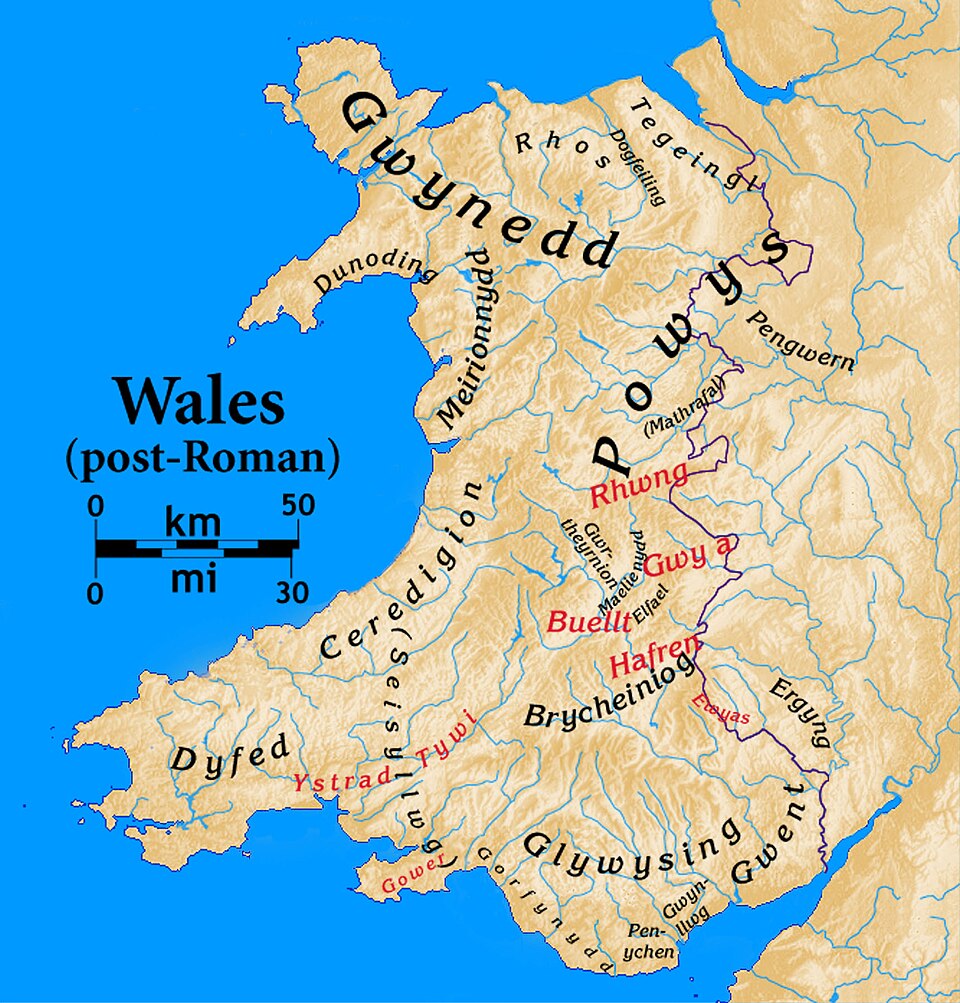 /
Post-Roman Wales, with its traditional kingdoms. From Wikipedia, which takes data from John Edward Lloyd’s 1912 History of Wales (2 vols.).
/
Post-Roman Wales, with its traditional kingdoms. From Wikipedia, which takes data from John Edward Lloyd’s 1912 History of Wales (2 vols.).

By the 14th-15th century her worship was well-established, and her church was rich. Dafydd says as much, and so does another poet, Dafydd Trefor.
Another source of great interest regarding Dwynwen’s cult is a copy of a 1494 Sarum Missal, which contains a manuscript addition consisting of the proper of two saints, Deiniol and Dwynwen. In the collect for the mass for St Dwynwen, it is said that God caused “Donwenna to cross from Ireland to Wales out of fear of King Maelgoinus, and adorned her there with diverse kinds of miracles” (courtesy of Google Translate). One might assume 16th century church-goers might have gotten confused, regarding the direction of her travels, for it was Dwynwen’s father, Brychan, that came to Brycheiniog from Ireland. Another kingdom in south Wales, Dyfedd, in modern Carmarthenshire, had seen substantial Irish migration too, and its rulers were Irish as well, and there we can find many Ogham stones in the traditional Irish script (see The Expulsion of the Déisi for the backstory). I say assume they might have gotten confused, for Maelgoinus is the Latin name of the Welsh king Maelgwn Gwynedd, king of, well, Gwynedd, in the early sixth century (and literally Hitler, according to Gildas, a saint, and our source for the decline and fall of pre-Saxon Britain). Or for the fact that Ynys Mon, where Dwyn retires to, is a notable part of the kingdom of Gwynedd, indeed when Glidas calls Maelgwn “the island dragon“(Maglocunus insularis draco, sounds kind of fire, I am not going to lie), it is typically assumed that the island is Ynys Mon (though the point can be made it is Britain that is the island). Maelgwn, “first in wickedness, exceeding many in power and at the same time in malice”. What a guy! He killed his nephew, and married the widow. But he had his good qualities, we’re told.
***
Gildas’ big point was that the Britons had lost their way, and that is why God had sent them the Saxons as punishment. Later on, the Saxons too would say the same when the Vikings invaded. War, war never changes, right? I see we’ve already ventured off-topic, and though I’d love to continue, indeed I wanted to continue and share my very, very, very limited knowledge of British history, this will be the end of it for today, if I want to get this out, well, today. Tomorrow, from the time of writing, but you know what I mean. I’ll just end on this: The reason why I did this post in the first place is because the algorithm brought me to the Armes Prydein, the Prophecy of Britain (next time), and then I remembered the coming date as I was on the phone with a dear friend of mine, who is young and in love, and then I remembered the last time I’d posted here (for I wanted to start doing so again regardless), and all of these events together made Dydd Santes Dwynwen the obvious decision. As if all of Reality and Creation had been pushing me towards this moment, that this was Destined to be, and could not have been otherwise. A sign from the Heavens, and I should rejoice! But I only notice it, and it seems to me so, because I am here doing it right now. I have no doubt that many other things have occured this month, and in my life as a whole, that, with the right final catalyst, would seem like they too were leading me to some final great Destiny, like foreshadowing in real life. One never sees the signs until what they had been suggesting has come to pass, and then one invents them to justify it all retroactively. I should use this in my writing, seems useful.
Thank you for your time, lol. And remember: I have no idea what I’m talking about, I’m neither British (thank God!!!) or a historian (sad!); not just not a historian but I lack even the smallest link to the humanities. For all you know I could be making this all up. Call me Iolo Morganwg the way I enjoy spreading lies. Call me Maleficent, the way I am productive of harm or evil.
***
Sources: (I promise I will come back and properly number my references, but please, have some mercy, I had to get this out today, none of this is my decision, and I wish it could all have been avoided)
Baring-Gould & Fisher, The lives of the British Saints : the Saints of Wales and Cornwall and such Irish Saints as have dedications in Britain; vol. 2, p. 387–92.
The National Library of Wales Journal, Vol. 27, 2, 1991, p.113-118, 121-123
Wade-Evans, A. W. “The Brychan documents.” Y Cymmrodor; 19 (1906): 18–50.
Transactions of the Anglesey Antiquarian Society and Field Club, 1920 & the appendixes and notes
J.A. Giles, English translation of De Excidio et Conquestu Britanniae by Glidas